


 Garantía de entrega





Artículo: AMZ-B0FSX5JZJ2
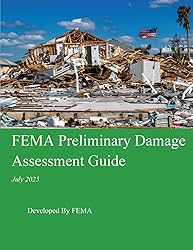
FEMA Preliminary Damage Assessment Guide: July 2025
Detalles del producto
Disponibilidad
En stock
En stock
Peso con empaque
0.44 kg
0.44 kg
Devolución
Sí
Sí
Condición
Nuevo
Nuevo
Producto de
Amazon
Amazon
Viaja desde
USA
USA
Sobre este producto
- Official PDA framework, distilled: How SLTT partners and FEMA collect, validate, quantify, and document disaster damage—end-to-end.IA & PA operations: Roles, responsibilities, and workflows for Individual Assistance and Public Assistance, with cost-of-assistance factors, per-capita indicators, and impact statements.Damage level standards: Clear Affected / Minor / Major / Destroyed definitions (with separate matrices for manufactured vs. conventionally built homes).Field-ready tools: Checklists, forms, and matrices (PA documentation, eligibility, and work-assessment; IA damage matrices; home insurance matrix).Tribal Nation guidance: Options to request declarations, sovereignty and cultural considerations, and joint PDA practices tailored to Tribal Nations.Product Description FEMA’s Preliminary Damage Assessment (PDA) Guide is the national reference for conducting joint PDAs and supporting Stafford Act disaster declaration requests. It sets a uniform standard so state, local, Tribal, and territorial partners—and FEMA—can assess disaster impacts quickly, consistently, and defensibly.Inside, you’ll find a complete PDA process overview (from IDA through the Governor/Tribal Chief Executive’s request), program-specific guidance for IA and PA, and validated methods you can mix and match in the field—windshield surveys, door-to-door assessments, digital surveys, desktop validation, and virtual sensing. Figures and tables walk teams through roles and responsibilities, damage validation, cost estimation, and declaration factors. Key quick-use references include: the IA damage matrices for manufactured and conventionally built homes; the PA documentation checklist, eligibility matrix, and work-assessment matrices (Categories A–G); plus a Home Insurance Matrix that clarifies what is and isn’t typically covered. For Tribes, Appendix D details declaration options, cultural site considerations, and PDA plan-of-action elements.What’s inside (at a glance):Process & governance: The PDA flow and its linkage to the Presidential declaration process (see Figure 3–4).Methodologies: Self-reporting, windshield & door-to-door, digital/desktop validation, GIS & remote sensing (Chapter 3).IA operations: Cost of assistance, damage level criteria, and impact statements (Chapter 4; Appendix H damage matrices).PA operations: Applicants, facility/work/cost eligibility, indicators, and documentation (Chapter 5; Appendix I–K).Tribal-specific considerations: Declaration pathways, cultural protection, housing ownership nuances (Appendix D).Tools & templates: Street sheets, site sheets, forms, and tech guidance (FACT, GIS, imagery)—(Appendix E & F).Who it’s for: Emergency managers, recovery leads, building officials, public works, VOAD/NGO partners, Tribal government staff, EOC planners, and anyone organizing or validating PDAs after storms, floods, wildfires, earthquakes, and other incidents.Specs: Paperback • 11 X 8• 116 pages • Edition: July 2025.Important note: This professionally printed edition reproduces FEMA’s Preliminary Damage Assessment Guide (July 2025) for convenient reference in training and field operations. It is not affiliated with or endorsed by FEMA; the source document notes it may be updated as FEMA refines doctrine.
$28,88
44% OFF
$16,05
IMPORT EASILY
By purchasing this product you can deduct VAT with your RUT number
$28,88
44% OFF
$16,05
Envío gratis
 Llega en 5 a 12 días hábiles
Con envío
 Tienes garantia de entrega
Este producto viaja
de USA ![]() a tus manos en
a tus manos en
![]()
 a tus manos en

Compra protegida
Disfruta de una experiencia de compra segura y confiable
![]() Garantía de entrega
Garantía de entrega
Con Tiendamia todas tus compras cuentan con Garantía de Entrega o devolución total de tu dinero.
Compras 100% seguras y garantizadas, para que pidas lo que sueñas y lo recibas del mundo a tu puerta.
Tarjetas de Débito y Crédito

Visa

Mastercard

American Express

Dinners

Discover

Alias
Pagos a través de PayPal
Compra procesada en dólares con dinero en cuenta o tarjetas internacionales.

PayPal

.svg)